


Wi-Fi 6 (802.11ax) Standards
Wi-Fi 6 (802.11ax) is the latest generation of the IEEE 802.11 wireless standard, designed to deliver stronger performance in high-density environments. It supports both 2.4 GHz and 5 GHz bands and brings several major enhancements, including:
-
MU-MIMO on both bands, allowing an AP to send and receive data from multiple devices at once, improving spectrum efficiency.
-
1024-QAM modulation, which increases data transmission efficiency by up to 25% compared with 802.11ac.
-
OFDMA scheduling that allows multiple users to transmit simultaneously, reducing delays and boosting throughput.
-
Spatial Reuse (SR) with BSS coloring to minimize co-channel interference by enabling devices to distinguish overlapping networks.
MU-MIMO Technology
MU-MIMO enables an access point to communicate with multiple user devices at the same time. This technology doubles spectrum utilization, supports more users, increases bandwidth, and significantly enhances the experience in busy environments.
Smart Antenna Array Technology
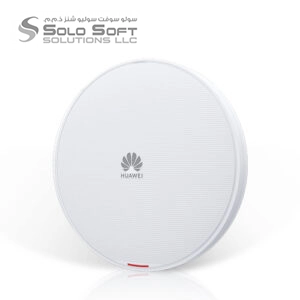
The AirEngine 6761-21 features a dual-band smart antenna array paired with an intelligent switching algorithm. It automatically detects its environment and user density, adjusting coverage patterns accordingly. This results in more accurate signal delivery, stronger coverage, reduced interference, and a smoother wireless experience for every connected device.
High-Speed Access
With advanced Wi-Fi 6 features—1024-QAM, increased subcarriers, and improved symbol scheduling—the AP delivers:
-
1.15 Gbit/s on 2.4 GHz
-
2.4 Gbit/s on 5 GHz
-
Up to 3.55 Gbit/s overall throughput
High Density Boost Technology
Huawei APs integrate multiple high-density optimization technologies to address issues such as congestion, signal interference, and poor roaming:
SmartRadio Optimization
-
Load balancing during roaming helps distribute device load evenly across APs, improving network stability.
-
DFA (Dynamic Frequency Assignment) detects interference and automatically adjusts radio configurations to reduce congestion and boost capacity.
-
Enhanced EDCA + airtime scheduling ensures fair and orderly channel usage, improving overall service efficiency.
Air Interface Optimization
In high-user environments, low-rate or weak-signal clients consume excessive resources. Huawei APs:
-
Reject weak-signal clients
-
Disconnect low-rate users to push them toward stronger APs
-
Improve airtime efficiency so more users can connect without degradation
5 GHz Preferred Access (Band Steering)
The AP supports both 2.4 GHz and 5 GHz bands but intelligently guides devices to the 5 GHz band first. This reduces congestion on 2.4 GHz and delivers faster, more stable connections.
Wired and Wireless Dual Security
Huawei APs combine both wired and wireless security mechanisms to safeguard all network traffic.
Wireless Authentication & Encryption
Supports all major security standards, including:
WEP, WPA/WPA2-PSK, WPA3-SAE, PPSK, 802.1X, and WAPI.
Non-Wi-Fi Interference Detection
Huawei APs can identify interference sources such as:
Bluetooth devices, baby monitors, wireless audio transmitters, cordless phones, game controllers, and microwave ovens.
With Huawei NCE-Campus, administrators can pinpoint the exact physical locations of interference sources for timely resolution.
Rogue Device Protection
With WIDS/WIPS, APs can detect, classify, and counter rogue APs or clients, ensuring a secure air interface.
Wired Security
APs secure their connection to the controller using:
CAPWAP protection, DTLS/IPsec encryption, and hardware-level encryption.
Automatic Radio Calibration
APs automatically scan surrounding devices, interference, and network topology. Based on the findings, each AP adjusts transmit power and channel selection to maintain optimal performance and stability across the entire wireless network.
Automatic Application Identification
Huawei APs feature Layer 4–Layer 7 traffic analysis, allowing them to:
-
Recognize over 6000+ applications
-
Prioritize or limit bandwidth
-
Block or schedule traffic
-
Optimize bandwidth use for critical services
Traffic statistics can be viewed by user, SSID, or entire network, providing full visibility and control.
Leader AP Mode
In small and medium-sized businesses, a leader AP can act like a lightweight controller. It manages multiple Fit APs without requiring a WLAN AC or licenses, reducing overall cost and simplifying deployment.
Cloud-Based Management
The AP can be fully managed through Huawei’s cloud platform, eliminating the need for an on-premises controller. Cloud mode supports:
-
PSK, Portal, SMS, and social login authentication without external servers
-
Cloud-based network design, deployment, monitoring, and maintenance
-
Zero-touch provisioning—simply power on the AP, connect it, and scan the QR code
-
Centralized monitoring of all devices, clients, and sites from a single dashboard
This simplifies deployment, cuts costs (CAPEX), and accelerates rollout for multi-branch businesses.
Reviews
There are no reviews yet.